Danny Hartman
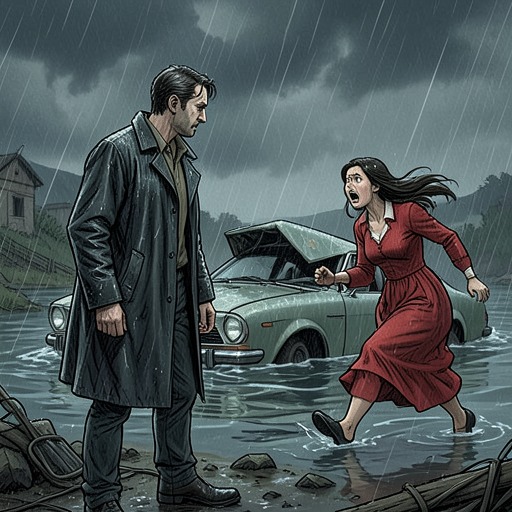
Exorcist FallsDanny Hartman is a Chicago police officer, a parishioner at St. Matthew’s Church, and the brother of Ron Hartman, but those positions of trust disguise his identity as the Sweet Sixteen Killer. First introduced as a reserved man asking a priest to help his nephew, he gradually emerges as a murderer who exploits family loyalty, police procedure, and the confidentiality of confession. His transformation makes his apparent protectiveness more than a red herring: it is the social cover that lets him approach victims and witnesses without immediately seeming dangerous.
Identity and Introduction
Danny is forty-one, of average height, lean but strongly built, with short dark-brown hair and a matching goatee. His eyes tend to dart away before their pain can be read. When he appears at Jason Crowder’s cottage at the rectory, he wears a navy-blue policeman’s cap. The description establishes a subdued, guarded presence rather than the conspicuous menace associated with a suspected serial killer.
At St. Matthew’s Church, Danny is a quiet parishioner who mostly keeps to himself and treats Jason Crowder with unusual reverence. That relationship helps explain why Crowder listens when Danny arrives with a family emergency. Danny introduces himself as a police officer working with Jack Bittner, his partner, and recounts a crisis involving his brother’s fourteen-year-old son, Casey Hartman. The ordinary particulars of Danny’s identity—officer, brother, uncle, parishioner—become the framework for the confidence others place in him.
Family Crisis and the Appearance of Protection
Danny describes Casey as a kind, unassuming boy with excellent grades, someone who had never been in trouble. He is Casey’s godfather and has known him since birth; he had even worried that Casey’s passivity might leave him vulnerable to other children. That affectionate account sits in painful contrast with the violence Danny reports. After Casey is locked in his room, Ron finds him kneeling at the foot of the bed and smiling in a way that does not resemble his usual expression.
Danny recounts how Liz Hartman tried to take Casey’s hands to stop him hurting himself. Casey then cut her hairline, struck her in the face, threw Ron across the room, and attacked Carolyn Hartman. Danny falters while describing Casey fumbling with his sister in a way no brother should. His distress presents him as a relative shaken by an intolerable scene, while his intimate knowledge of the family gives his account persuasive force.
When the police arrive, Danny says the only way he could stop Jack Bittner from taking Casey to jail was to insist that a priest examine the boy first. He also says he wanted to stay and protect Casey when Bittner returned. Those choices place Danny between police procedure and family concern: he uses his standing as an officer to delay an arrest, then casts himself as the boy’s guardian. Yet Bittner suspects Casey of being the Sweet Sixteen Killer, making Danny’s advocacy look like an effort to protect a vulnerable child and, in retrospect, a way to control how the case is handled.
The house itself initially offers no visible confirmation of the horror Danny describes. Jason Crowder and Danny enter a sprawling, stylishly decorated historical home, with a thirty-foot foyer and a baby grand piano in the parlor, before Liz appears. The contrast between a composed domestic interior and Danny’s account of violence sharpens the uncertainty surrounding Casey—and the reliability of the people claiming to protect him.
From Trusted Witness to Exposed Killer
Danny’s access to Crowder carries into the investigation. He knows that the Sweet Sixteen Killer visited Crowder’s confession booth three days earlier, information Crowder presents as the reason he can identify the killer’s presence in the confessional. Danny is therefore positioned near both the police investigation and the church’s private disclosures. Those roles converge when, after the deaths of Bittner and Peter Sutherland, Danny and Crowder agree on a simple public account: they will say that the demon possessed Casey, that Bittner committed suicide, and that Sutherland killed himself after attacking Crowder. Liz agrees to repeat their version. The arrangement shows how Danny can participate in shaping an official explanation even as the underlying events remain concealed.
The concealment breaks when Crowder recognizes that Danny knows details from things Casey said while Crowder was alone with him. Danny had not been in the room for most of those statements, yet he understands them. Crowder also points out that Danny was staying in the same house when the demon invaded Casey. Rather than offer an ordinary explanation, Danny acknowledges the connection through a sinister smile and proposes a mutual bargain: each will keep the other’s secrets. The exchange recasts his earlier presence in the Hartman home. He was not merely an uncle responding to a family emergency; he had been close to the possession and to information Crowder thought private.
The next day, the Sweet Sixteen Killer strikes again, killing Makayla Howell, who is sixteen. Crowder concludes that Danny intends to frame him for the new murder and possibly for the earlier killings as well. He is already a chief suspect in the deaths of Bittner and Sutherland, despite Liz and her children speaking in his defense. Crowder fears Danny may connect Peter Sutherland to the earlier crimes and make him answer for Makayla’s death. The danger is no longer only Danny’s ability to kill: he can use the credibility of his police position and the confusion around prior deaths to redirect suspicion toward Crowder.
Danny makes the conflict physical when he surprises Crowder in the living room and wounds him in the abdomen. Standing close enough to speak at Crowder’s ear, he taunts him about the pain and about a prom date Crowder had mocked. The attack turns a personal grievance into a means of domination: Danny asks whether the wound has made the two men understand one another better. His intimacy is now unmistakably threatening, a deliberate reversal of the deferential parishioner Crowder first knew.
Relationships, Motives, and Recruitment
Danny’s family ties are both genuine parts of his identity and cover for his violence. As Ron’s brother, he can enter the Hartman family crisis without seeming an outsider; as Casey’s godfather, he can claim a special responsibility for the boy. Casey later identifies his uncle as the person responsible for the harm attributed to him, naming Danny rather than himself. That disclosure exposes the gap between Danny’s public defense of his nephew and the threat he represents within the family.
His relationship with Liz is more disturbing still. In the tunnels, Danny describes watching his brother’s wife, staring at her body, and taking pleasure in having seen her changing. He says he repeatedly wondered why she did not leave Ron and get into bed with him. The confession makes clear that his apparent concern for the Hartmans coexists with sexual entitlement toward Liz. His attention to her is not presented as mutual intimacy; it is a pattern of covert looking and imagined possession. The contrast between his position as a relative who could be trusted in the home and the private gaze he describes exposes how proximity can become a tool of violation.
Danny’s relationship with Jack Bittner likewise connects professional trust to concealed danger. Danny identifies Bittner as his partner, and later enters a room to find Bittner’s slumped form toppling sideways. The partners’ professional bond becomes part of the setting in which suspicion and death accumulate. When Detective Ambrose later distinguishes the Bittner matter from the accusations against Crowder, he says Crowder had nothing to do with it; this further complicates the earlier suspicion surrounding Crowder without, by itself, spelling out every detail of Danny’s responsibility.
Danny extends his violence beyond the original series of victims by recruiting Tyler Raines. Raines says he and Danny have been partners for only a couple of days, after his previous partner committed suicide. He recounts Danny telling him about a murder before it happened, presenting foreknowledge as an inducement into the secret. Danny calls the new associate an apprentice; the first seven girls are attributed to Danny, and he now has an accomplice. The language turns murder into a corrupt form of instruction, with Danny not merely hiding his actions but attempting to pass them on.
Exposure and Narrative Significance
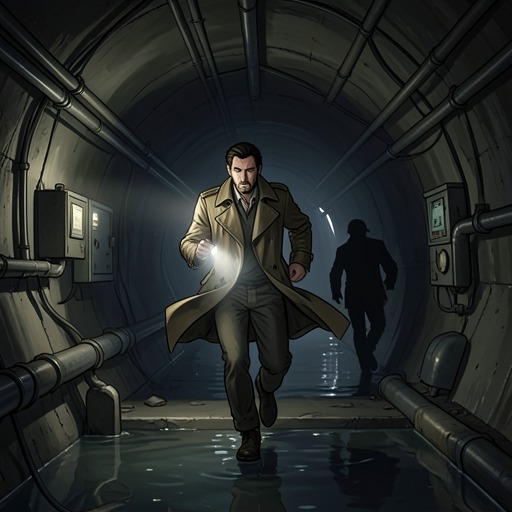
Crowder identifies Danny’s use of the tunnels on the night he killed Mary Ellen Alspaugh. The accusation ties Danny to a particular murder and to the city’s concealed underground routes, extending his crimes beyond the family home and police partnership through which he first appeared. The tunnels also provide the setting for Danny’s extended, intimate confession about his desire for Liz, where his words carry over the roar of the river. His self-revelation does not make him remorseful: it exposes the attitudes beneath his violence while he remains a threat to Crowder.
The confrontation ends with a fillet knife sinking into Danny’s eye. The moment is brutally physical, but the evidence given here does not establish his eventual fate, so the injury marks the climax of the encounter rather than a confirmed death. What is certain is the collapse of Danny’s protective persona. The uncle who intervened for Casey, the officer who managed the story, and the parishioner who showed Crowder reverence are revealed as facets of the same murderer.
Danny’s narrative role depends on that gradual reversal. He is introduced through another person’s distress and through the trust attached to family, police work, and church life; only later do the unexplained knowledge, the threats, the wound, and the murders reorganize those details into evidence of deception. His story also makes the institutions around him part of the suspense: a police partnership can conceal as well as investigate, family loyalty can silence suspicion, and confession can bring information into a priest’s orbit without making its source immediately clear. Danny’s most effective disguise is not an invented identity but the ordinary legitimacy of being someone the people around him already know.